
Using trugs in your phonics teaching
Whichever synthetic phonics programme your school uses, trugs lines up beside it to be used as intervention or enrichment, matched to what a child can already decode.
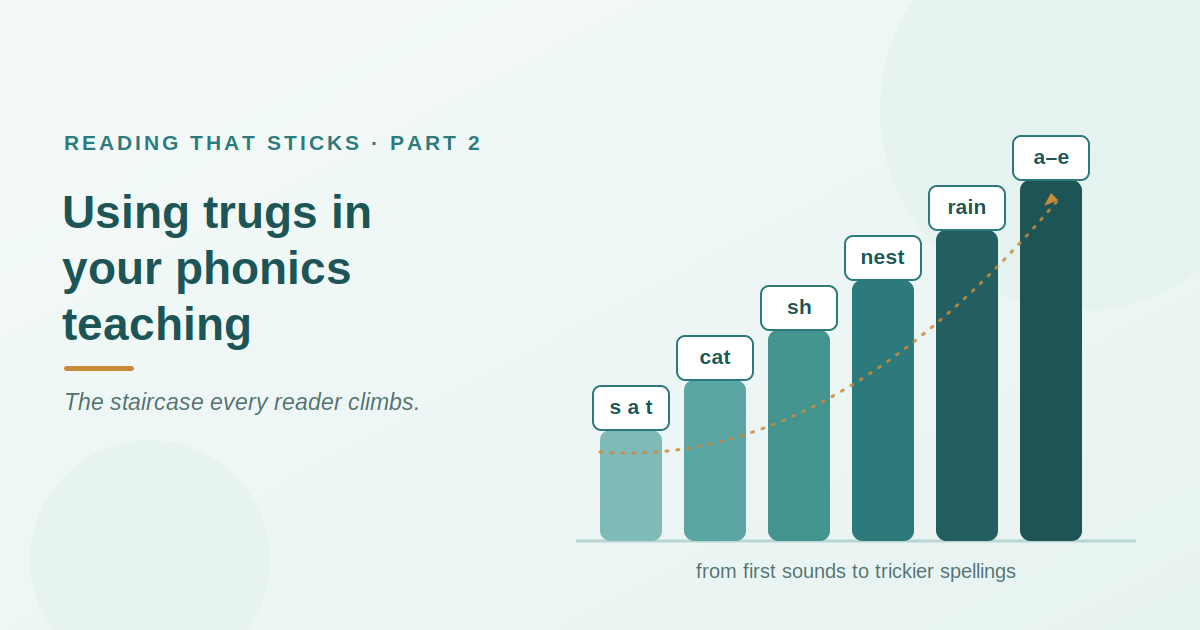
In Part 1 we looked at the staircase every reader climbs, from oral blending up to the trickier spellings, and three ideas that run through this series: the volume of successful practice is the lever; place a learner by what they can decode, not by their age; and trugs follows the progression and supplies the practice — it doesn’t replace the teaching. This part is about that last idea in the classroom. Whatever programme your school has chosen, trugs is built to sit beside it.
A single staircase, many programmes
The reason trugs fits alongside any scheme is that every validated programme climbs the same staircase, they just use different names for the steps. Little Wandle Letters & Sounds Revised and Essential Letters & Sounds both run on the Letters and Sounds phases. Read Write Inc. uses its own Sets 1–3, with “special friends” for digraphs and “Fred Talk” for sounding out. Sounds-Write works through an Initial Code and an Extended Code. Different language, same underlying order of decoding.
Because trugs follows that same order, it maps onto all of them. Here is the shared staircase with each programme’s equivalent, and the matching trugs pack:
| Decoding step | Little Wandle & ELS (Letters and Sounds) | Read Write Inc. | Sounds-Write | trugs |
|---|---|---|---|---|
| Oral blending; first sounds | Phase 1 → early Phase 2 | Set 1 sounds; Fred Talk | Initial Code Unit 1 | Stage 0 |
| CVC words (cat, pin) | Phase 2 | Set 1; Word Time | Initial Code Units 1–7 | Pack 1 |
| First digraphs & double letters | late Phase 2 → Phase 3 | Set 1 “special friends” | Initial Code Units 7, 11 | Pack 1 |
| Adjacent consonants / blends | Phase 4 | Set 1 four- & five-sound words | Initial Code Units 8–10 | Pack 2 |
| Vowel digraphs (rain, week) | Phase 3 vowel digraphs | Set 2 long vowels | early Extended Code | Pack 2 |
| Alternative spellings & split digraphs | Phase 5 | Set 3 | Extended Code | Pack 3 |
Please note that programmes differ on whether adjacent consonants or vowel digraphs come first, which is why trugs Pack 2 spans both. Remembert to match by the step a child is actually on.
For a Little Wandle or ELS school there’s an even simpler headline: trugs Pack 1 supports Phases 2–3, Pack 2 supports Phases 3–4, and Pack 3 supports Phase 5. For a Read Write Inc. or Sounds-Write school, you match by decoding skill. The same GPCs, in the same order the programme already teaches. Either way, trugs isn’t asking a teacher to plan around anything new; it’s reinforcing what’s being taught.
Two ways to use trugs: intervention and enrichment
In practice, trugs does one of two jobs, depending on the child. As intervention, it gives the child who is slipping behind extra, targeted practice on exactly the step they’re stuck on, without waiting for the whole class or adding anything new to learn. Take a Year 1 child in a Little Wandle keep-up group who is secure on Phase 2 but stalling on the Phase 3 vowel digraphs – ai, ee, igh. Ten minutes of Pack 2 with a supporting adult after lunch, on those exact digraphs, gives the blending repetitions the morning lesson couldn’t, and closes the gap before it widens. It reinforces the same sounds, in the same order, that were taught that morning.
As enrichment, it extends and consolidates the confident child, protecting their momentum. A Reception or Year 1 pupil who is flying through the early phases can take Pack 1 home as a game that another adult or sibling can play without any phonics expertise. This keeps low-stakes, enjoyable practice going in step with the class. The point isn’t to race ahead onto new sounds; it’s to build fluency and enjoyment on what’s already secure. This is where lasting confidence comes from.
And because a game is age-neutral, the same tool supports the learner the early-years window has already closed on. A Year 5 pupil still working through the early stages, who might still be working on a Sounds-Write Initial Code, practising four- and five-sound blends (eg lamp, nest, grand) needs the right level in an age-appropriate format. trugs Pack 2 gives them grown-up, motivating practice on exactly that, without the infant-style materials. Sounds-Write itself teaches through games, so it feels like more of the same rather than something bolted on.
Start where the child is
The thread throughout is: place by decoding skill, not age. Before reaching for a trugs pack, the useful question is never “what year group is this child in?” but “what can they already decode, and where does it break down?” A quick check (a few words from each pack) gives the answers and sets the entry point, whether the learner is five or fifteen. That places the practice precisely where the leverage is.
The mechanics of that placement check; how to run it, how much and how often to play, and how class, one-to-one and home use differ, will be laid out later in the series. For now, focus on the principle: trugs meets a child at their step on the staircase, and reinforces the programmes schools already use.
Coming next — Part 3: trugs for dyslexia and SpLD. For learners with dyslexia and other specific learning difficulties, structured programmes such as Orton-Gillingham and Alpha to Omega do the teaching. Part 3 will look at how trugs supports them, and at the one thing these learners can never have too much of.