
Teaching a child to read can be a daunting task, for parents, for tutors, and even for experienced teachers watching a struggling reader stall on the same three sounds for the third week running. That’s exactly the problem trugs (Teach Reading Using GameS) was built to solve, and it’s why the resource has spent the last few years quietly becoming one of the more trusted names in synthetic phonics practice.
But trugs hasn’t stood still. Just as the children using it are constantly moving through their own reading journey, sound by sound, word by word, stage by stage, trugs itself is in the middle of its own metamorphosis. The core has never changed: structured, synthetic-phonics card games that make decoding and spelling practice feel like play rather than work. What’s changing is how many ways there now are to get that practice into a child’s hands, at school, at the tutor table, or round the kitchen table at home.
What trugs is, and why it still works
At its heart, trugs is a set of games built on synthetic phonics principles. Each pack is reversible by design: the same cards that build decoding skills also build spelling skills, because a child has to segment and blend sounds to win, not just recognise a word by sight. That reversibility is what makes trugs different from a flashcard deck or a phonics worksheet, the games are genuinely competitive, genuinely fun, and children play them because they want to, not because they’ve been told to.
That distinction matters. A game is age-neutral in a way a worksheet rarely is: a nine-year-old who feels embarrassed practising sounds on a page will happily play a card game with exactly the same content, because it doesn’t read as remedial. trugs supplies the practice; it was never meant to replace good teaching, and it still doesn’t. It sits alongside a phonics programme as reinforcement giving the repetition a child needs to move a skill from effortful to automatic.
Built for the classroom, the tutor room, and the kitchen table
Teachers reach for trugs because it maps onto national curriculum phonics stages and gives them a low-prep way to reinforce what’s already been taught, without another worksheet to mark. Parents reach for it because you don’t need to be a phonics expert to sit down and play a card game with your child, the rules do the teaching for you. Plus tutors, who often need something structured but flexible enough to fit a single session, have their own Tutor Pack built around exactly that.
A metamorphosis already underway
Here’s where things are moving. Demand from all three of those groups; schools, tutors, and home has pushed trugs to expand well beyond the original card packs, and the new printables and pop-out trugs packs are the best example of it yet.
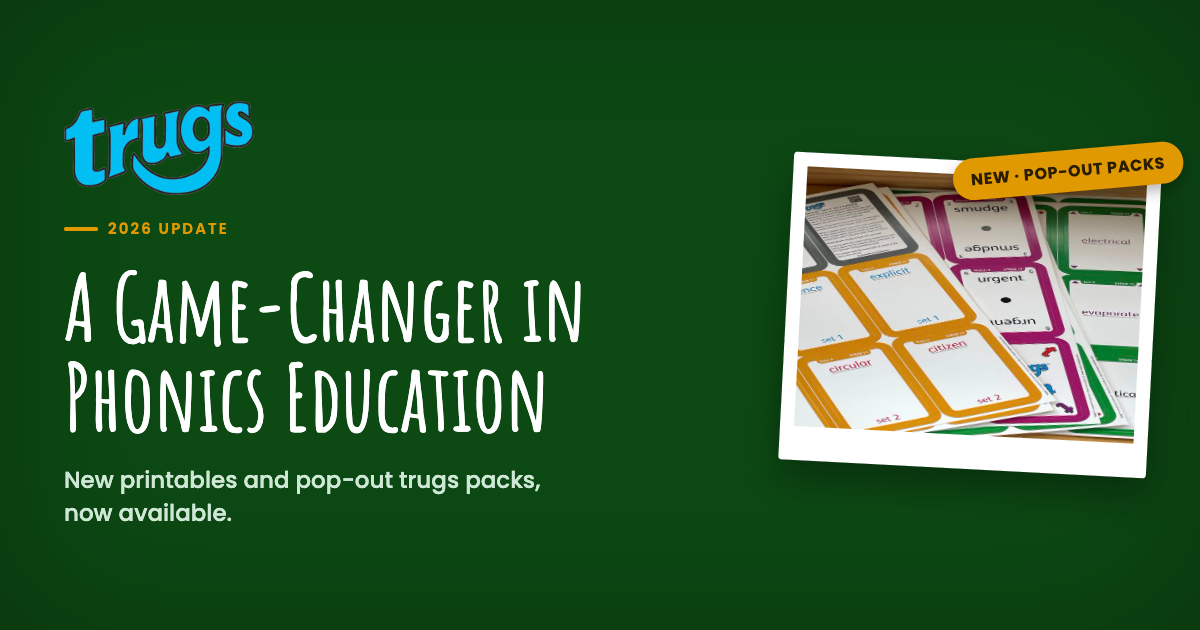
The new pop-out packs take the same reversible, game-based cards trugs has always used and put them into a punch-out sheet: no scissors, no trimming wonky edges at the kitchen table at 9pm, just pop them out and start playing. It’s a small change with a real payoff for anyone assembling a set for the first time, or a teacher restocking a set that’s had a hard term.
The printable PDFs open things up even further. Because they’re downloadable, there’s no waiting for delivery, a teacher can have a stage ready to print before the next lesson, and a parent can start that evening. They’re available across the full stage range, from Stage 0 right through to Stages 11–15, with personal-use licences for home and tutoring from £10, and school licences covering a full block of stages for £75, an easy way for a school to top up a set, replace lost cards, or equip an extra classroom without reordering physical packs and waiting for them to arrive. And because it’s a PDF, it’s genuinely reusable: print it again next term, or for the next child, at no extra cost.
None of that changes what a child is actually doing with the cards in front of them; segmenting, blending, playing to win. It’s a genuine shift in how trugs reaches people, not a change of direction, but a change of shape. The same DNA, more forms for it to take, and a much easier way in for anyone starting today.
Positive changes on the horizon
This growth isn’t finished. Over the coming months, expect the printables and pop-out range to keep expanding, alongside the wider stage coverage and app support that already sits behind trugs. If you’ve used trugs before and it’s been a while, it’s worth another look and if you’re coming to it for the first time, there’s now more than one way in. Keep an eye out for new resources and even games in the App Store. We are back and we are getting bigger and bolder.
Whichever door you come through; classroom, tutor session, or a rainy Sunday afternoon at the kitchen table, the goal hasn’t moved: turn the hard, daunting work of learning to read into something a child genuinely wants to do again tomorrow.
Explore the current trugs range, printables, and pop-out packs at readsuccessfully.com, or get in touch at trugs@readsuccessfully.com.