
Why trugs? Phonics, practice and the readers who need more
How reading is taught today, why some children need far more practice than others, and why a game turns out to be the right tool for the job.
Learning to read is the most important thing a child does in their early years at school and for many, it doesn’t happen smoothly. This series is about how reading is taught now, why some readers need much more practice than others to get there, and where trugs fits into the picture. This first part sets out the thinking; the three that follow show; how it works in the classroom, in dyslexia and SpLD support, and in day-to-day practice.
For the last twenty years or so, English schools have moved towards a single, agreed way of teaching children to read words. Two ideas from the Rose Review (2006) still shape every classroom.
The first is the Simple View of Reading: understanding what you read is the product of two things working together; being able to read the words on the page and being able to understand language. A child needs both. Phonics is how we build the first.
The second is that children should learn to read words through systematic synthetic phonics – sounding out and blending individual sounds to read a word, taught in a planned, cumulative order. This is written into the National Curriculum and checked, at the end of Year 1, by the Phonics Screening Check.
The most recent guidance, the DfE’s Reading Framework (2023), restates all of this and, importantly for what follows, extends it. It is also clear that systematic phonics matters just as much for older pupils who still can’t read words confidently, and that it is the most effective approach for children who find reading hard, taught at a steadier pace with plenty of repetition, or “over-learning”.
If you didn’t learn to read this way yourself, the terminology can be off-putting. It’s simpler than it sounds.
- A phoneme is a single sound in speech – the /k/ at the start of cat. A grapheme is the letter or letters that spell that sound – the “c” in cat, or “sh”, or “igh”.
- A grapheme-phoneme correspondence (GPC) is just the link between the two.
- Synthetic phonics teaches these correspondences in a fixed order and then has children blend them: c-a-t → cat.
- Some common words can’t be sounded out neatly when a child first meets them – the, said, were, one. These are taught as tricky words, recognised on sight, until later phonics knowledge makes them decodable too. Good teaching handles both.
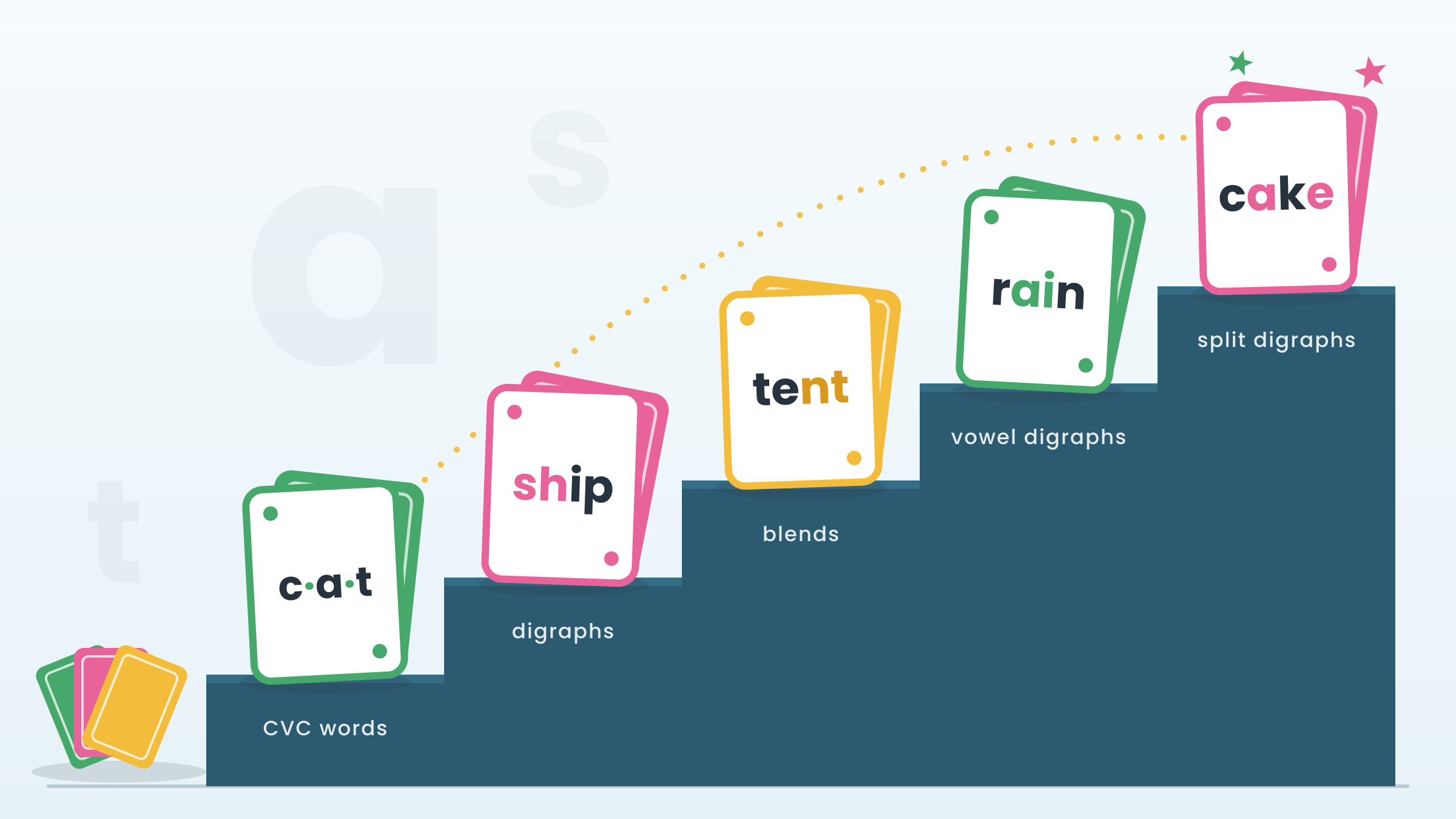
These build the staircase every reader climbs.
Whatever programme a school uses, children learn to decode in broadly the same order, like a staircase from the simplest sounds to the most complex spellings. It’s worth having this picture in mind, because everything in this series comes for this.
Example of what a reader can decode;
- Oral blending; first letter sounds, hearing c-a-t as “cat”
- Simple CVC words, cat, pin, dog
- First digraphs and double letters, sh, ch, th, ng; ss, ll, ck
- Adjacent consonants (blends), tent, spot, twist
- Vowel digraphs, rain, week, night, boat
- Alternative spellings and split digraphs, play/paint; cake, these, kite
A child doesn’t move up a step until the one below is secure. This is the single most useful idea for anyone supporting a struggling reader, and it leads straight to the first of three ideas that run through this whole series: place a learner by what they can decode, not by their age. A twelve-year-old who stalls at vowel digraphs needs practice at that step, not at the beginning, and not where the rest of the class happens to be.
Using games as practice. Here the research is striking. Decades of reading study (most famously Stanovich1986) show that small early differences in decoding compound over time into very large later gaps in reading. Stanovich called this the Matthew Effect, after the biblical line about the rich getting richer. The mechanism is a cycle: a child who cracks the code early finds reading less effortful, so they read more; reading more builds vocabulary, knowledge and fluency, making them stronger still. A child who doesn’t crack it reads less, falls further behind, and the gap widens year on year.
Stanovich’s conclusion was blunt and useful. You cannot break that cycle with general enrichment; you break it with precise, targeted work at decoding, and, above all, with volume. What most separates strong readers from weak ones is how much successful reading practice they accumulate. That is the second idea running through this series: the volume of successful, rewarding practice is the lever.
And this isn’t only theory. England’s PIRLS 2021 results found that a child’s Year 1 Phonics Screening Check score was the single strongest predictor of their reading attainment at age 10, a direct, present-day measurement of the cascade Stanovich described nearly forty years earlier. Get decoding secure early, and later reading tends to follow.
Where does trugs fit? trugs is a phonics game programme that follows the systematic synthetic phonics progression. It runs fifteen cumulative decodable stages, sequenced by the same grapheme-phoneme correspondences, in the same building order as the staircase above, with separate practice for the tricky words children can’t yet decode, and a pre-decoding Stage 0 for the very start. Each stage offers three games, so the same sounds come round again through different kinds of play. Some games ask a child to sound out and blend fresh words; others consolidate words already grouped by the sounds they’ve learned.
That structure follows the same architecture the framework asks for: decodable progression and explicit handling of exception words, in the order schools teach them. The difference is what a game adds, that progression delivered as rewarding, repeatable practice. This is the third idea for the series, and the one the rest of it pivots on: trugs follows the progression and supplies the practice; it doesn’t replace the teaching. It sits inside a school’s approach, not alongside it.
Because it’s a game, children choose to repeat it which matters enormously, since it’s the volume of successful practice that changes outcomes.
Another important point is that trugs isn’t just for the early years. Most phonics resources are built for the infant classroom. trugs certainly works there, but one of its real strengths is the older child who still hasn’t cracked decoding. A worksheet can’t always meet that child comfortably; a nine, twelve or fourteen-year-old who needs to practise blending isn’t going to engage with infant-style materials, and being handed them can feel demeaning. A game is age-neutral: it gives a struggling reader of any age a motivating, grown-up way to practise the decoding they missed. For a specialist teacher or tutor picking up a learner who has fallen behind, or a parent supporting a teenager who is quietly struggling, that dignity is part of what makes the practice happen at all.
This, again, is where the Reading Framework now points: systematic phonics for older pupils who haven’t yet learned to decode, and as the most effective route for learners who find reading hard.
Coming next – Part 2: Fitting trugs into your phonics teaching. Whichever synthetic phonics programme your school uses, trugs lines up beside it. We’ll look at how it maps onto Little Wandle, Read Write Inc., Essential Letters & Sounds and Sounds-Write and how to use it as intervention or enrichment, matched to what a child can already decode.